Wednesday, October 3, 2018

Editing Your Novel - Part 1 Finish First Draft

by Elva Cobb Martin
Good editing is like going through a gate to an exciting, better book. Here I am entering a Georgetown,SC, rice plantation. I refused to let the rain hinder my tour or photos.
How do you write your novel? Where does editing come in?

For me, the real editing begins after the first draft. 

I write the first draft mainly to get the plot points down, tell the story, hit the major scenes I've already planned. I work hard and fast getting my opening set up, hitting important scenes in the middle, and writing the major ending scenes, including the black moment and the HEA. 

If I try to do a lot of editing in the first draft, I may never get to THE END. I know folks, like me earlier, who struggle years trying to write that "novel." But it takes so long if you try editing as you go along, for example, editing what you wrote yesterday before going on today. Trust me, that's going up the ladder backwards. 

When I finish that first draft, I might have 45,000-50,000 words, but will need 60,000-80,000 words for the final draft, according to what a publisher I've queried might ask for.

Reviewing, here's what works for me in novel writing to finish that first draft:

1) I spend quality time planning that first draft. Planning your novel is described in my 10-part series earlier in this blog. Find Part 1 here http://bit.ly/2zPmZa1

Here's the list of the other 9 parts in the archives:

Part 2 -  Premise
Part 3 -  Pitches and Book Tags
Part 4 -  Characterization Special -Dancing Horse & Heroine
Part 5 -  Deep Heroine Characterization
Part 6 -  Hero Characterization
Part 7 -  Secondary Characters
Part 8 -  Outlining
Part 9 -  Choosing the best opening scene
Part 10 - The Fiction Proposal

So don't fudge on your novel planning. It will help that first draft be a fast birthing! I've learned since writing that series that making a time line of historical events to cover my historical series will be a great help. 

So you finished your first draft! Congratulations!

It's a wonderful accomplished feeling to finish the first draft.
Can't you hear the success bells ringing when any one asks, "How is your novel coming along?"  And you can answer. "Fine, I've finished the first draft."

Celebrate every goal reached!

So once I finish the first draft, it's time to go back through and add all the spit and polish, including great sun rises and sun sets if on a sailing vessel like I often spend time. 

Three vital questions I ask myself to begin editing after finishing the first draft: 

1) Do I need to add more scenes to reach my word count or       add more detail in scenes to make more vivid?

b) Am I staying in Deep POV and not head hopping? For my 4-Part series on DPOV click here for Part 1:  http://bit.ly/2EyAtdK.

c)  Am I using the five senses, strong verbs, strong adjectives?

Hey, thanks for stopping by. Hope this has helped you today.
I will go in much more detail about editing a first draft in Part 2 next week. Please leave a comment if this has helped and share on your social media by clicking on the icons below.

Blessings on your writing,
Elva Martin


Elva Cobb Martin is vice-president of the South Carolina Chapter of American Christian Fiction Writers. She is a former school teacher and a graduate of Anderson University and Erskine College. She has two inspirational novels published with Lighthouse Publishers of the Carolinas. Summer of Deception, a contemporary romantic suspense, and an historical romance, In a Pirate’s Debt. Both have spent time on Amazon’s 100 Best Sellers List for Women’s Religious Fiction. She has indie published a Bible study on Amazon, Power Over Satan, on the  believer's authority in Christ. Decision, Charisma, and Home Life have carried Elva's articles. Jim Hart of Hartline Literary represents her. She and her husband Dwayne are semi-retired ministers. A mother and grandmother, Elva lives in South Carolina. Connect with her on her web site http://www.elvamartin.com,on Twitter www.twitter.com/ElvaCobbMartin; Facebook http://www.facebook.com/elvacobbmartin;  and Pinterest https://www.pinterest.com/elvacobbmartin    

 Link to her romance novels and non-fiction works on Amazon:http://amzn.to/2pOgVHI


Friday, September 21, 2018

Guest Blog "Writers' Police Academy"

By Guest Blogger Fran Stickland Anderson


Writers' Police Academy - Crime and Suspense

Just arrived home from a conference for writers of suspense and police procedurals, the Writers’ Police Academy in Green Bay, Wisconsin. The academy is a hands-on opportunity for authors who want to experience for themselves the field of law enforcement with some firefighter, first responder, and sometimes a dive team thrown in for good measure. There won't be many pictures to prove my participation because photography and videos are not allowed in many of the classes  to protect those officers whose identity in undercover work might be compromised.

I did take the photo here of my husband and me in some tactical gear. David participated in a timed session of putting on and taking off the gear, which was cumbersome and heavier than expected and consisted of half pants, a bulletproof vest, and a weapon belt.

 I loaded and fired a Glock at an indoor range, participated in a simulated shooter incident training, learned the proper defense and arrest tactics of using a baton to gain control of a situation, sketched the face of a wanted criminal, watched a burn house demonstration, a dive team demonstration, and much more. My main observation was that my mind could learn just about anything, but my body reflexes were slow at getting the lesson. Not sure anyone there would want me as their partner on the street. Law enforcement training involves three areas of preparation: mental, physical and emotional, because all reflexes must work in tandem. Life and death decisions are made in nanoseconds.

As a writer, it is important to write as real as possible, even for a world of make believe. Readers learn a lot about the world around them when books accurately reflect life.

A well-written, well-researched story will convey an officer’s biological need to help others, his/her desire to fix other’s problems, the courage to take and maintain control of a situation, his inability to turn off the adrenaline produced from engaging in confrontational circumstances, and his persistent observation of the immediate world around him, unable to shut down that training even in his personal time.

The Academy’s trainers consisted of actual police officers, detectives, a forensic artist, a former undercover agent, a former prosecutor, martial arts expert, interrogation expert, representatives from SIRCHIE, manufacturer of investigative-related solutions, and much more. My husband (he’s a writer too) and I were up at 5:30, at breakfast by 6:30 and on the bus by 7:15. We rode to an international police training facility and participated in classes from testifying in a court of law and the world of undercover to hands-on physical training and microscopic murder weapons. Between 4:00 and 4:30 we boarded the buses back to the hotel where we attended another class between 4:30 and 6:00. Each evening between 8:00 and 10:00 the entire group would gather for one more session.

We met many accomplished authors, learned more than we will ever be able to retain, and arrived at the end of each long day thoroughly exhausted. To close the conference Saturday evening, Jeffrey Deaver, the keynote speaker, who also attended the academy classes along with the rest of us, encouraged us by sharing the early publishing struggles of now-famous and prolific writers.

I would encourage anyone who is serious about writing material that contains elements of law enforcement to attend the annual Writers’ Police Academy to help authenticate their manuscript. Getting the details right makes for a more believable read.

Getting the correct details of any situation in life is important as well before making a judgement (which can be considered merely an opinion or a sensible conclusion according to Oxford Dictionaries).

I always like to leave you with an encouraging word from the one book that has it all, romance, intrigue, murder, deception, crime, and investigative wisdom….the Bible.

“…then you shall investigate and search out and inquire thoroughly.”
                                                  ***
HOPE YOU ENJOYED THIS GUEST BLOG by Fran. If so, please do share by clicking on the small icons below.

Blessings,
Elva Marttin
Fran Strickland Anderson
Fran Strickland Anderson is president of the ACFW South Carolina Chapter and is also a member of the Foothills Writer’s Guild and Blue Ridge Writers. She is a contributor to several of the Moments series books published by Grace Publishing and the First Draft Society’s Inklings series. Her current work-in-progress is a redemptive suspense novel entitled Roots That Run Deep. Fran is married to David, is mother of Jake, and resides in upstate South Carolina where she works full time as an assistant city manager. Her blog, Scattering Words and Sowing Seeds (scatteringwordsandsowingseeds.blogspot.com), seeks to entertain, encourage, and inspire both writers and non-writers as they navigate life’s challenges. Most of her stories are still waiting to be told.

Scattering Words and Sowing Seeds
Sharing words that entertain, encourage and inspire!

Facebook and Linked In Fran Strickland Anderson


Friday, September 14, 2018

The Birth of the U.S. Navy - For my novel research

by Elva Cobb Martin

Today I am sharing a column by Bill Federer on The Birth of the U. S. Navy. This is part of my research for my historical romance series. Hope you enjoy! You can sign up for his email list. You may also like to order his wonderful book of answered prayers in the founding of America which is  shown below.


American Minute with Bill Federer
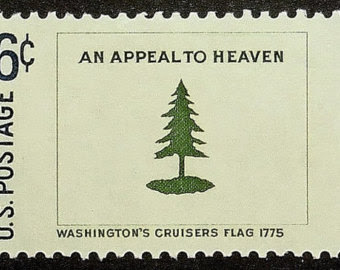
"AN APPEAL TO HEAVEN" - The birth of the U.S. Navy & Coast Guard
In June of 1775, citizens acting as merchant marinerscaptured the British schooner HMS Margaretta around Machias, Massachusetts (present-day Maine).
That same month, General George Washington, with the help of merchant ship owner Colonel John Glover of Marblehead, Massachusetts, chartered and outfitted several ships to interrupt the British supplies.
The marker at the base of John Glover's statue in Boston states:

"John Glover of Marblehead - A Soldier of the Revolution.

He commanded a regiment of one thousand men raised in that town known as the marine regiment, and enlisted to serve throughout the war.

He joined the camp at Cambridge, June 22, 1775, and rendered distinguished service in transporting the army."
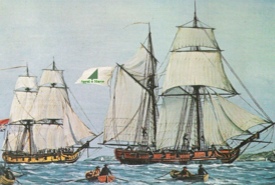
The first ships outfitted by Glover were named Hannah, Franklin, Warren, Hancock and Lee.

They had crews of experienced fisherman who defended American ports and raided British ships carrying ammunition and supplies.
55 British ships were captured by this original American flotilla.

One of these was then the Leecaptured the British brig HMS Nancyon November 29, 1775, with its cargo of 2,000 Brown Bess muskets, 100,000 flints, 30,000 of artillery ammunition, 30 tons of musket ammunition, and a 13 inch brass mortar.

This was a tremendous benefit to the new Continental Army.
After the Battle of BrooklynHeights, August 27, 1776, John Glover and his Marblehead fisherman saved the day by evacuating Washington and the entire Continental Army, under cover of fog, in their miraculous escape across the East River to Manhattan Island.
Glover's large Durham rowboats also ferried Washington and the Continental Army across the ice packed Delaware River for the surprise attack on the German Hessian troops at the Battle of Trenton, December 26, 1776.
The Continental Congress, on December 22, 1775, had authorized a Continental Navy,consisting of five ships, the Alfred, Columbus, Andrew Doria, and Cabot.

It was put under the command of Esek Hopkins, Esq., and four captains, Dudley Saltonstall, Abraham Whipple, Nicholas Biddle and John Burrows Hopkins.
Congress also commissioned five first lieutenants, one of whom was the future naval hero, John Paul Jones.
American ships flew the Pine Tree Flag, designed by General Washington's secretary, Colonel Joseph Reed, who wrote in a letter, October 20, 1775:

"... flag with a white ground and a tree in the middle, the motto AN APPEAL TO HEAVEN."
The Pine Tree Flag was also flown in towns, churches, riverbanks, and at the nation's capital in Philadelphia.
Eastern White Pine Trees grew to a height of over 150 feet and were ideal for use as masts on British ships.
These pines contributed to the British navy becoming the most powerful navy in the world.
In 1734, there was a Mast Tree Riot where men disguised as Indians chase away the King's surveyor.

In 1772, New Hampshire had a Pine Tree Riot.
The King sent agents to enforce his claim to every tree in New England over 12 inches in diameter.

In 1772, when the sheriff came to South Weare, New Hampshire, to arrest those who had cut down some of King's trees, 30 men busted into the sheriff's room at the inn at night, with their faces blackened with soot in disguise, and beat the sheriff sore with switches made from pine branches.

The men were later arrested and forced to pay a fine.

It was a test of the King's authority and considered by some as the beginnings of the revolution.
The Pine Tree Flag's phrase, "An Appeal to Heaven," was first used by John Locke in his Second Treatise on Civil Government, 1690, regarding the right of citizens who have been denied justice to go above the king's head:

"Where the body of the people ... is deprived of their right ... and have no appeal on earth, then they have a liberty to appeal to heaven ...

Where there lies no appeal on earth ... they have just cause to make their appeal to heaven ...

Where there is no judicature (justice) on earth, to decide controversies amongst men, God in heaven is judge.He alone, it is true, is judge of the right ...

So in this ... he should appeal to the Supreme Judge."
Patrick Henry stated at the Second Virginia Convention, March 23, 1775:

"An appeal to arms and to the God of hosts is all that is left us! ... We shall not fight our battles alone. There is a just God who presides over the destinies of nations."
Massachusetts Provincial Congress stated April 26, 1775, following the Battles of Lexington and Concord:

"Appealing to Heaven for the justice of our cause, we determine to die or be free."
The Massachusetts Navy flew a similar Liberty Tree Flag, with the line "An Appeal to God."
The Declaration of Causes and Necessity for Taking Up Arms, July 6, 1775, stated:

"We most solemnly, before God and the world ... resolved to die freemen rather than to live slaves ...

With an humble confidence in the mercies of the Supreme and Impartial Judge and Ruler of the Universe."
The Declaration of Independence, July 4, 1776, stated:

"We, therefore ... appealing to the Supreme Judge of the world for the rectitude of our intentions, do ... declare, That these United Colonies are, and of Right ought to be Free and Independent States."
America's first navy grew to over 40 vessels, but was disbanded after the Revolutionary War.

The Massachusetts Navy continued, and was later incorporated into the U.S. Navy.
On AUGUST 4, 1790, the Revenue Marine, later called Revenue Cutter Service, was created by the recommendation of Alexander Hamilton,the Secretary of the Treasury.

It consisted of 10 ships charged with stopping smuggling and French privateers from operating in American waters.
                                                 ***
Thanks for stopping by. Would love to hear your comments. Please share on social media by clicking on the small icons below.

Elva Martin

Elva Cobb Martin is vice-president of the South Carolina Chapter of American Christian Fiction Writers. She is a former school teacher and a graduate of Anderson University and Erskine College. She has two inspirational novels published with Lighthouse Publishers of the Carolinas. Summer of Deception, a contemporary romantic suspense, and an historical romance, In a Pirate’s Debt. Both have spent time on Amazon’s 100 Best Sellers List for Women’s Religious Fiction. She has indie published a Bible study on Amazon, Power Over Satan, on the  believer's authority in Christ. Decision, Charisma, and Home Life have carried Elva's articles. Jim Hart of Hartline Literary represents her. She and her husband Dwayne are semi-retired ministers. A mother and grandmother, Elva lives in South Carolina. Connect with her on her web site http://www.elvamartin.com,on Twitter www.twitter.com/ElvaCobbMartin; Facebook http://www.facebook.com/elvacobbmartin;  and Pinterest https://www.pinterest.com/elvacobbmartin    

 Link to her romance novels and non-fiction works on Amazon:http://amzn.to/2pOgVHI