Showing posts with label writing tips. Show all posts

Friday, August 19, 2016

My Journey to a Book Contract - Part 4 Master GMC and MRU's

by Elva Cobb Martin


We continue "My Journey to a Book Contract" and honing your craft. This is Part 4. You can access Parts 1-3 in our archives.


Master “Goals, Motivation, and Conflict” 
(check out a great book with same title by Debra Dixon)

Your hero, heroine and even other characters should have a:
        Goal – What they want
        Motivation – Why they want it
        Conflict – The why not (what stands in their way)
   
   Internal and External Needs evolve into Goals, Motivation, Conflict which drive the story.
           Carolyn Greene says inner conflict is what gives characters’ something to think about.
           External conflict propels the plot and gives characters something to do.
           Inner needs can be universal and intangible: respect, acceptance, security, safety, love
           External needs should be tangible and resolvable:  justice, revenge, the truth, job promotion   

Example: Kirsten Arnold wrote on a Seekerville blog comment her idea at Internal and external GMC & logline.

Log Line/Pitch: A rugged Alaskan hunting guide must save the younger brother of the woman he loves while learning to accept the forgiveness that can set him free and open the door to love and life. 
    
Who: Cooper Maitland: Alaskan outfitter/hunting guide

External GMC: Cooper wants to help the FBI catch drug traffickers operating as Alaskan fishermen, and save Bryce Wallace the kid brother of McAye Wallace the woman Cooper loves.
Internal GMC: Cooper wants to forgive himself and accept God’s forgiveness for the terrible mistake he made that cost McAye’s sister her life. His love for McAye stands in the way, because it serves as a constant reminder of his past and keeps him mired in guilt.


Master MRU’s - Motivation Reaction Units

(Should be in this order but don’t have to include all 4)

  1) Physical or gut level
  2) Thought
  3) dialog (can be combined with action)
  4) action

Incorrect Order (example from my draft of Summer of Deception)

Rachel looked at him for a long moment. First the housekeeper, now this man. Wasn’t anyone expecting her? A sting shot through her empty stomach. But she shook off her uneasiness. Everything could be cleared up in two seconds. She dug in her handbag. “Mr. Barrett offered me a summer position. I have his note here.”

Corrected Order
A sting shot through Rachel’s empty stomach. Wasn’t anyone expecting her? First the housekeeper, now this man. She looked at him a long moment and cast off her uneasiness. Everything could be cleared up in two seconds. “Mr. Barrett offered me a summer position. I have his note here.”
She dug in her handbag.

What helped you master GMC or MRU's? Please leave a comment and share this blog on your social media by clicking on the icons below.

Elva Cobb Martin

Thursday, July 16, 2015

The Beauty of Brevity

by Guest blogger Julie Lessman

Hello, Julie Lessman here, and despite the fact that most of my books can be used as doorstops, I do believe the statement above bears some truth. Which is probably why the judge mentioned above did not score me very high on A Passion Most Pure. Sigh. Because the truth is, I’m just one of those 500+page authors who thinks the only definition of “brief” is Hanes underwear. 


But honestly, can I help it if I was at the end of the alphabetical line when God gave out talents, gifting me with verbosity rather than brevity?

Yes, I can. And so can you. 

Don’t get me wrong. I’m not saying that most of our prose has to be short and succinct because frankly that would be pretty boring, and the majority of us would be out of business. But I am saying that we need to use our words wisely. It’s my contention that every single word we use in a sentence should have a purpose, be it for clarity, description, rhythm, pace, drama, analogy, etc.—or just plain beautiful sound. 

Another judge once told me that if our sentences are too beautifully written, to the point they stop a reader in his or her tracks just to reread it for sheer pleasure, that’s not a good thing. Apparently this judge felt that anything that stops the flow of the novel—including beautiful phrases or sentences—risks pulling the reader out of the story, thereby distracting from the overall pleasure. 

I couldn’t disagree more. 

Yes, I agree you NEVER want to pull a reader out of the story with things like:

Inaccurate Historical Facts (i.e. I originally had chocolate chip cookies in my WWI-era A Passion Most Pure when they weren’t invented until mid-30s)
Chalkboard Word Usage (i.e. words that are so wrong, they almost sound like fingernails on a chalkboard, such as one book I read where the author had the heroine “skipping up to her front door” during a tragedy)
Unfeasible Plot Points (you know, the kind that make you roll your eyes? )
Unnatural Dialogue
Incorrect Etymology (i.e. I have read some form of the term “wrap one’s mind/brain around it in at least six historical novels when this is clearly a modern term)
Trite or Overused Phrasing (i.e. At least half the novels I read have some form of the phrase “his/her smile did not quite reach his/her eyes, including my first book, so now when I see it in any book, I cringe).
—Poor Grammar or Typos (i.e. When I was a travel writer, the biggest typo I ever made was in a travel piece on Kauai in which I praised the island’s beaches with the following sentence: The island of Kauai is famous for its beautiful whores (should have been shores).
—Run-on sentences
—Lack of Clarity

But beautiful prose that captures your heart? Oh, honey, I highlight phrases like this in every book I read, often earmarking those authors as new favorites because of their gift with words. And I’m not alone, either. Check out this article by Jennifer Schafer of BuzzFeed on 51 Of The Most Beautiful Sentences In Literature.

Soooo … I thought it would be fun to list some “beautiful” brief lines from some of my favorite authors including the Seekers, along with the author’s explanation (or mine) as to why they (or I) love their particular line(s). Keep in mind that my definition of “brevity” is a sentence or sentences that accomplish any of the following things in a mere sentence or so, packing more punch into a novel with the least amount of words.

—Inspires
—Educates
—Paints a Picture
—Reveals a Truth
—Is Clever
—Is Humorous
—Is Profound
—Challenges
—Transports the reader
—Steals One’s Breath
—Elicits Emotion

HERE WE GO:

1.) He wept. — The Bible, John 11:35. The shortest verse in the Bible, but surely one of the most potent and powerful in Scripture.

2.) My parents were lace-curtain Irish, righteous as three popes. —Irish Born by Nora Roberts. This is a line that has stayed with me when I used to read secular novels, and the reason is that in nine measly words, Nora Roberts painted an entire heritage for me that spoke volumes in very few words. 

3.) Too tiny for six and too thin for any age, she had long dark hair caught in a single, bedraggled braid and blue eyes awash in fear and wishes.Texas Tea by Mary Connealy from The Seekers new Historical Novella collection, With This Spark. I love this description by Mary because it paints such a vivid picture of the heroine as a child, plus the slight “sh” alliteration with “blue eyes awash in fear and wishes.”

4.) Though the air carried the scent of mowed grass, spring flowers and fresh-turned dirt, the vile odors that had clung to Max filled her nostrils still, as if he stood at her side, not laid out at her feet. The Bounty Hunter’s Redemption by Janet Dean, a strong sensory description that Janet says, “tugs at her heart when widow Carly recalls the terrible marriage she’d endured as she stands before her dead husband’s grave.”

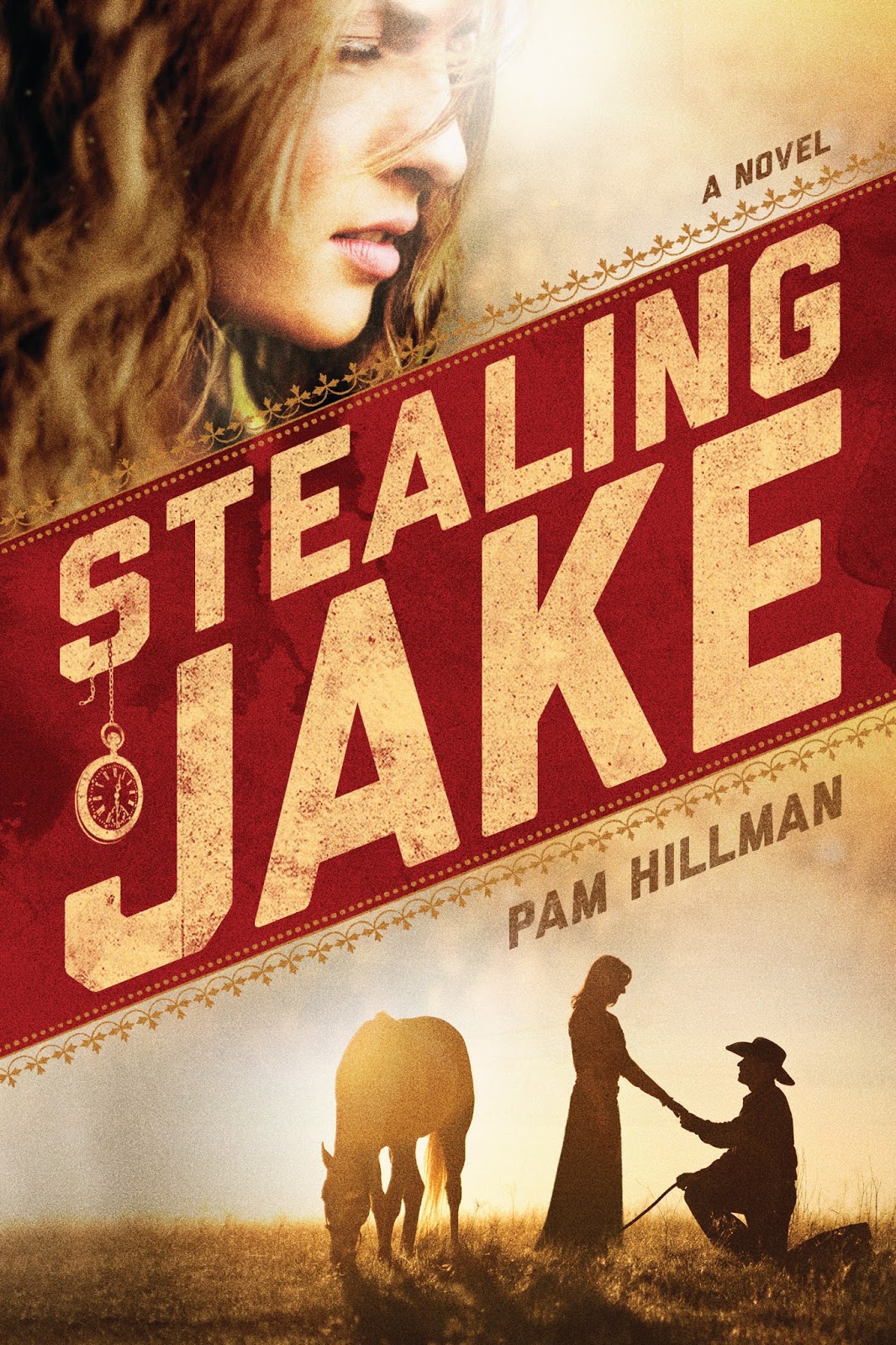
5.) I DON’T WANT TO GO BACK TO THAT LIFE. EVER.Stealing Jake by Pam Hillman, who told me, “I received my copies of Stealing Jake last week and the sentence Tyndale put on the back slapped me upside the head. Seeing those ten words, bam, bam, bam, brought Livy’s struggle back full force. The line isn’t beautiful, but it is powerful.” I agree, Pam!

6.) Drops of rain fell, then paused. The wind increased, and the trees lining the road’s edge rubbed together, whining. — Healing the Lawman’s Heart by Ruth Logan Herne. Ruth likes this line because it’s “all about timing. Gods. Ours. Our ineptitude. Our inability to listen the first time.... when we really should.” I like it because of the word “whining,” soooo audible and visual!!

7.) He stepped into her personal space and she realized that the tantalizing aroma she’d smelled when she first walked into the house was the fragrance of coming home.No Time for Love from the With This Kiss Contemporary Collection by Tina Radcliffe, who says, “this is from the heroine's point of view as she realizes she has fallen in love with the hero. It succinctly says it all for her.” For me, too, Tina, because “coming home” for each of us often relates to smells.

8.) Hope had never served her well. — The Thorn Bearer by Pepper Basham. I Frankly, I had trouble picking just one of Pepper’s lines because she has a gift for unique phrasing. I chose this one because it’s short and powerful.

9.) He wanted desperately to stay, just a little while longer.  But he couldn't be here, in this place, with her.  It was calm here.  She was innocent and beautiful and perfect. 
         He was not.  He didn't want his mess or his mental illness or his past anywhere near her.  He wanted to protect her from a lot of things, but most of all from himself. A Love Like Ours by Becky Wade, who says, "These lines are among my favorites from A Love Like Ours because I love romance!  To me, it’s just plain old romantic when a tough, battle-scarred man (like Jake Porter) tries everything in his power not to fall for his heroine.  And can’t help falling for her anyway.  That struggle, that tension, is just so juicy to read!"

10.) And finally, since I’m obviously more familiar with my own favorite lines in my books AND because this is my blog, here’s a few phrases and lines from my books along with why I like them:

As writers, we are always looking for new ways to say things and bring emotions to the surface in a visual way, so I am especially fond of the following phrases because to me, they are like movie “action” clips that I can actually see, per a prior blog of mine, Keeping It "Reel" ... Or a "Novel" Approach to Putting a Movie in Your Reader's Mind.

A Passion Most Pure:

A sick feeling cowered in her stomach.

The oxygen swirled still in her lungs.

Heat roared to his cheeks.


AND here are a few full lines from my books and just why I like them:             
                            
He studied the strong line of her jaw, the lush, full lips so ripe for tasting, the graceful curve of her neck plunging toward a body that took his breath away. Friends? Not likely. Okay, for some reason, I love the word “plunging” here because it has a double meaning that applies to the hero as well, who is “plunging” into the waters of attraction against his will.

Dear God in Heaven, he wanted her … but he didn’t want her. I really like the accent-mark effect on the word “her” in this line, which to me, states two different feelings in the hero while using the same word.

His lips were white, his eyes red, and a vein in his temple throbbed a dangerous blue. Not a good color combination. This just makes me smile every time I read it, and if you knew the cantankerous hero, Mitch Dennehy, you’d smile too!

A woman who was a feast to his eyes but a drought to his soul. I am really fond of opposite analogies that describe the same person or thing because it deepens and broadens the description, in my opinion.  

His statement drifted in her brain, its impact silent, slow, and deep, like a knick she didn’t know she had until she saw the blood on her hand. I absolutely love this line, because as a person who gets a LOT of knife cuts in the kitchen because I don’t feel them, this perfectly describes how my character feels when the hero says something that shocks her to the core.

Why?” he asked quietly, and the word made her flinch, like a sudden shaft of light in a dark cellar where roaches and rats skittered. I hate roaches, and I flinch and freeze if I ever see them when I turn the light on in our basement. It’s an awful feeling, and one that describes my heroine’s reaction perfectly when a terrorizing truth about her is revealed.

Cluny sat ramrod straight on the couch like the garden gnome in the neighbor’s yard, displaying a nervous amount of teeth in a cast-iron grin. To me, a steel grin and spine screams guilt while the idea of a garden gnome also highlights the fact that 14-year-old Cluny is inside on a sunny day, much to the hero’s angst.

Sweet thunderation—deliver me from pretty men! For me, this line sets up the story in so little words—introducing a Texas heroine who’s been dumped at the altar by a fortune-seeking pretty boy.
Okay, we’re done, and this blog may not be brief, but it IS one of my shortest, so that has to count for something, right??? 

GIVEAWAY:
Now it’s your turn—tell us some of your favorite lines from your own work or from other authors, and I’ll enter you in the drawing for your choice of any of my books, including my upcoming indie novel, Isle of Hope, which releases this fall and is, by the way, my longest book to date. Sigh.

ABOUT JULIE:
In addition to being verbose, Julie Lessman is the award-winning author of The Daughters of Boston, Winds of Change, and Heart of San Francisco series, was named American Christian Fiction Writers 2009 Debut Author of the Year and voted #1 Romance Author of the year in Family Fiction magazine’s 2012 and 2011 Readers Choice Awards. Julie has garnered 17 RWA and other awards and made Booklist’s 2010 Top 10 Inspirational Fiction. Her latest novel, Surprised by Love, appeared on Family Fiction magazine’s list of Top Ten Novels of 2014. Her indie book A Light in the Window is an International Digital Awards winner, a 2013 Readers' Crown Award winner, and a 2013 Book Buyers Best Award winner. 


You can contact Julie and read excerpts from her books at www.julielessman.com, or through Facebook, Twitter, Google Plus, or Pinterest, as well as sign up for her newsletter. Check out Julie’s group blog, The Seekers, Writers Digest 2013, 2014, and 2015 “Best 101 Websites for Writers,” and Julie’s own personal blog, Journal Jots, voted blog of the month in the Readers’ Choice poll of Book Fun 
                                           ***

Thanks for stopping by today. Hope you enjoyed Julie Lessman's blog I decided to share. Do leave a comment and share on twitter and FB if you liked it.

Elva Cobb Martin

Friday, April 24, 2015

Write Small - Five Ways to Make a Reader Care - Guest post


 Hope you enjoy this guest post by Mia Botha today! --Elva Cobb Martin


Guest Post by Mia Botha:

I have found my new all-time, favorite writing advice:
'The bigger the issue, the smaller you write. Remember that. You don't write about the horrors of war. No. You write about a kid's burnt socks lying on the road. You pick the smallest manageable part of the big thing, and you work off the resonance.' ~Richard Price
I love this quote. You may have come across it before, but I saw it on Pinterest last week and I have been staring at it since. Think of the best stories - you always remember the small details.
Often, when I teach, I listen to students talking of the great stories they want to write. They want to write about wars where hundreds of lives are lost, marriages that end in divorce, the loss of a child or a horrible parent. All big issues. All great topics.
But when do I, as the reader, start caring?
  • I care when I meet the soldier, scared out of his wits, hiding in the trench, trying to light a soggy cigarette, wishing he could see his girlfriend just one more time. 
  • I care when he throws away the cigarette and kisses her photo before climbing out of the trench to face the enemy.
  • I care when I learn that the little girl who died liked drawing purple unicorns and that she drew a new one every day she spent in hospital. I cry when her mother takes them down. I cry because there are 42 pictures and I cry because there will never be 43.
How do I write small?
1.      Create a character: How do I get to the kid’s burnt socks? I create a mother or a soldier who walks down the road and comes across them. Think of Saving Private Ryan; Private Ryan was only one soldier, but because they singled him out, he made us aware that all soldiers have families, mothers, and fathers. They are not nameless, faceless, camo-wearing, gun toting soldiers anymore. They are all someone’s son.
2.      Give that character a concrete goal: If it is a war story, then yes, the character wants to survive. But try to give them a simpler goal in the midst of the survival. Maybe, to fulfil his mother’s dying wish or in the case of The Book Thief, all Liesel wanted was a book to read. Even though a war is raging, everyday life continues.   
3.      Write with the senses: Burnt socks? You can smell them right now, right? Gunshots? You can hear the bang, bang, bang. Purple unicorns? You can see them. You can see the round shapes left by the Prestik on the glass doors of the ICU as the mother pulls down her little girl’s pictures for the last time.
4.      Find your theme: War and Death of a loved one might be too generic. Consider them ideas and they are good places to start. Work hard to make your theme specific. The farther along you get in your story the more you will be able to identify the theme. This will help you pick out the details you want to highlight.
5.      Symbolism: Once you have made your way through a draft identify scenes where you can repeat symbols. Burnt socks? Maybe give me the moment when the little boy got them. They were blue and yellow and had Batman on them. Just like his big brothers.  
Write small about the big things. Make your reader care.
Happy writing.   
If you want to learn how to write a book send an email to  news@writerswrite.co.za for more information.
  by Mia Botha

Mia Botha facilitates for Writers Write. She is also a novelist, a ghost writer, and the winner of the Mills&Boon Voice of Africa Competition. When she isn’t writing, she is the mother of two children and the wife of a very lucky man. Follow Mia on Pinterest  and Facebook and  Tumblr  and  Twitter.

Monday, April 13, 2015

Plotstorming a Novel

by Elva Cobb Martin


Cheryl Wyatt shocked me in a blog some time ago when she said she tended to write a rough draft of a novel in a week. And I want to give her credit for some of her ideas I am going to share. She writes action-romance.

How does she do it? She does a lot of prep work she calls plotstorming before she starts writing the rough draft.This includes doing Character Charts first on the main characters. (For her it also includes cooking and freezing a week's worth of meals for her family during her Weeklong Rough Draft Writing Spree).

Then comes her Plotstorm List

The Cute Meet: How will the heroine/hero meet?
The Draw and the Push: What plot element will keep drawing the two together and what conflict will be prying them apart?

Hero and Heroine's Story Goals
Hero and Heroine's Motivation
Hero and Heroine's Conflict: External, Internal, Spiritual, Relational
Story Setting
Inciting Incident: The chaos, disaster, dilemma, or change that opens        the story and becomes Scene 1/opening hook.
Relationship Reticence - hero
Relationship Reticence - heroine

1st Major Disaster
2nd Major Disaster
3rd Major Disaster aka Black Moment

Important Ancillary character: important character, other than hero or heroine, who is most central/important to the plot.

Basic Premise: A one-sentence summary or paragraph blurb of the basic story idea.

Scene Index Skeleton: (Not a chapter chart). One-liner plot points describing what goes into each major scene. (Normally, she has three scenes per chapter and around 20 chapters, so that's 60 scenes).

The Resolution:


In a romance she always know the H/H will get together in the end. 


Once Cheryl has all the above decided, she's ready to write her first draft in a week. 

What about you? Can you use some of these ideas to jumpstart your next novel. I did to write my second novel and it does work.

Please leave a comment and get ready to plot storm your next novel.

Elva Cobb Martin


Tuesday, March 31, 2015

45 Ways to Avoid Using the Word "Very" --Guest Post

Guest Post by Amanda Patterson

Have you had to work at eliminating the word "very" in your writing? I have and this chart by Amanda Patterson has been a godsend.  Print it out. It's a keeper, especially during the editing process.


Amanda Patterson has a great blog you can follow at Posthaven Posts or email her at  news@writerswrite.co.za

Do leave a comment if you find this post helpful and share on twitter and facebook.

Hope you are blessed anew in this Resurrection week!

Elva Cobb Martin


Friday, January 9, 2015

Rejection - Forcing Life Into My Wings

by Elva Cobb Martin

The lovely Emperor Moth has an interesting life story that helped me get through a rejection in my inbox this week. Here's a bit about the moth. Maybe it will help you.

A woman once kept a cocoon of an Emperor Moth for a year waiting for it the moth to emerge.
The cocoon had a strange construction in that the neck had a very narrow opening through which the mature insect would have to force its way. 

The great disparity between the size of the opening and size of the imprisoned moth made the onlooker wonder how the insect would ever emerge. She studied and found that it is believed the pressure to which the moth's body is subjected when passing through such a narrow passage is nature's way of forcing fluids into the wings.
And she could hardly wait to see those beautiful wings.

One day she witnessed the first efforts of her imprisoned moth to escape from its long confinement. She watched for some time as it patiently struggled to be free. It seemed unable to get beyond a certain point. Finally, the woman decided to give the moth a helping hand. With the point of her scissors, she snipped the confining threads to make the exit easier. The moth immediately rolled out, dragging a swollen body. The woman was sure she'd soon see the wings expand into their beautiful colors that were all there in miniature. But she looked in vain. The moth suffered an aborted life and only lived a few minutes.

Writing is a lot like writhing as you struggle to master the craft and edit and rewrite and rework and redo the whole process as long as it takes to escape from Unpubbed Island. 

I've decided to mark down the rejections in this struggle in honor of the Emperor Moth. They are part of the pressure that is simply forcing life into my wings!


How do you handle rejections? Do you feel like doing this?


Thanks for stopping by. Please join the conversation and share this blog on twitter and face book by clicking the buttons below.

Elva Cobb Martin

Note: Resources for this blog include Streams in the Desert and Bing Images.


Friday, December 19, 2014

Writing Smarter and Sharper by Elva Cobb Martin

I have started back through my historical novel, In a Pirate's Debt with a critiquer's eye. I made a list of things I need to watch for, items my good critique partners might point out. These cover areas beyond the basics.

And, like all good things, they do take time so pull over out of the traffic of your to do list today with me and get your pencil sharpened.
1) Delete/change too often used ing verb forms (being, having, walking) and avoid overuse of prepositional phrases. :
  The duck is holding up traffic walking across the road.
vs. A mama duck and ten ducklings strutted across the stacked four lanes and no one blew a horn.    

Getting involved with Travay could pose a threat to his      (Captain Bloodstone's) goal of finding out what happened to his captured parents.
      vs: He did not have time to get involved with her. He must pursue his goal. He must find out what had happened to his parents.

2) In deep POV don't say the character "heard, thought, wondered" anything. Just give the actual fact.

  She heard the boy call the pirate Captain Bloodstone.
  vs. The boy called him Captain Bloodstone.
(Of course, if you're looking into the face of Gerard Butler as Atilla, you won't be able to hear anything but your heart pounding against your ribs).

3) Avoid naming emotions, show them.

     He made her feel safe.
vs: She expelled a huge breath, her eyes locked on the source of relief.
     She was grateful for the rescue.
vs: Her eyes softened and filled with an inner glow when she looked up at him.

4) Keep all dialog, action, and thoughts of each character in
the same paragraph unless interrupted by other speaker.
(Which can happen. Particularly if the other person is holding something behind their back.)

5) Use contractions in dialog.

6) Ellipses: space-dot-space-dot-space-dot-space
    "But . . . Arundel!"
    "Could it possibly be that . . . ?" (fourth dot or question mark is end of sentence)  

7) Can't use description tags like the below in current POV to comment on something said.
    Lucas looked out to sea as if to end the conversation. 
    vs. Lucas looked out to sea and Thorpe sauntered away.

8) I am told we no longer indent the first sentence of a new chapter or a POV change. Center the 3 *** for POV changes.
Use center button, not space bar. Then temporarily drag paragraph indent marker to left to finish centering.

Have you got all this, Elizabeth? 


Thanks for stopping by. Do you have a good tip to add to my list? I would love to hear from you.

Have a blessed Christmas and Wonderful New Year-- my prayer for you.

Elva Cobb Martin


Thursday, September 4, 2014

Interview with author Gina Holmes

Please welcome, novelist, Gina Holmes. Gina is the founder of popular literary site, http://novelrocket.com   She is a two-time Christy and ECPA Book of the Year finalist and winner of the INSPY, Inspirational Reader’s Choice, and Carol Award. Her books regularly appear on Christian bestseller lists.


Gina, tell us a little about your newest release, Driftwood Tides.

Driftwood Tides tells the story of an aging, alcoholic driftwood artist turned beach bum, Holton Creary, and young Libby Slater. Libby grew up with an absent father and a loving but cold, socialite mother. Leading up to her wedding, Libby and her groom-to-be go through genetic testing and she learns her blood type doesn’t match either of her parents. She confronts her mother and is reluctantly told that she’s adopted. She goes searching for her mother, Adele, only to find her husband, Holton Creary lying face down on the carpet of his Nags Head beach shack.

She lies about her real identity until she is finally found out. Holton does not welcome the news. He never knew the wife he had given saint status too had given up a daughter for adoption. Together the two search to find the truth about Adele, Libby’s father and themselves.

What do you hope readers will take away from this book?

At its heart, Driftwood Tides is really about discovering who we are, whose we are, where we belong and the need to accept and bestow forgiveness.

Why did you set this novel in Nags Head?

Oh, how I love that place! I’m not sure there’s a more peaceful setting in all the world. And the further out I get from civilization, the happier I am. I love the sand dunes, the untouched nature, the quaint towns. Just everything! Well, except sand in my bathing suit maybe ( :

You seem to have a recurring theme in your novels about absent fathers, if it’s not too personal, why do you think that is?

It is too personal, but I don’t mind answering (wink!) When I was 6 years old, I was packed up by my stepfather and driven to my father’s house. Overnight I had a new Mom, new sisters and brother, house and life. It was as traumatic an experience as I can imagine. There were few explanations that made sense to me and I missed my other family desperately. I think ever since I’ve been trying to settle some pretty deep-seated questions. Writing books is wonderful for that.

The novel you’ve written that seems to be a fan-favorite is Crossing Oceans, do you ever see yourself writing a sequel?

I love that book too. Makes me cry just thinking about certain scenes. I would love to write a sequel, prequel or off shoot stories. I love those characters dearly. I’m under contract for three different novels, so I’m not sure when I’ll have the time, but I’d love to explore Craig’s story and of course, Bella’s. I miss Mama Peg very much!

You’ve said that your favorite novel you’ve written is Wings of Glass. Why is that your favorite?

Well, for storyline, I think Crossing Oceans is the strongest. I think my writing in Wings of Glass was my best, plus when I was very young I watched my mother in one abusive relationship after another, and then two of my sisters. I had been there too, despite thinking I was better than that. I know the mindset that keeps a woman (or man) in a relationship like that and I wanted to give insight to those who don’t understand. I’ve received enough letters to know I did what I set out to do.

You’re originally from NJ but write all your novels from the South, why do you set your novels down South if you’re from up North?

Ha, you found me out! Yes, I was born and raised in NJ. As much as I love my friends and family, I am definitely more suited for the slower pace of the South. I’ve lived in Southern VA for half of my life and I plan to spend the rest of my life here if I can help it. I try to write books from settings that make me happy. So I write where I want to be. (Although, I’ve got to say, NJ food is amazing and you’ve got to love a boisterous NJ laugh!)

What do you like most about being a writer? Least?

Most, I like being able to have a platform to share lessons I’ve learned in my life that I know others would benefit from. And more than that, I just love to tell a good story.

Least,would be the unpredictability of the business. Sometimes it seems so random and the lack of control makes me uncomfortable sometimes. (Which is probably right where God wants me!)

Do you have any advice for aspiring novelists?

My advice is pretty much always the same. 1. Write. So many people want to have written but don’t actually do the work. 2. Get to a writers conference because there’s so much you don’t know, that you don’t even know you don’t know. If you don’t you’ll be spinning your wheels for years, wasting valuable time. 3. Run, don’t walk, to the nearest bookstore and buy yourself a copy of Self-Editing for Fiction Writers. Then apply it. (Best money I ever spent!) 4. Join a good critique group and get a nice thick skin, ‘cause you’re sure going to need it!

If you could go back to the pre-published writer you were, knowing what you do now, what advice would you give her?

Well, I wouldn’t have told myself how many novels I’d write that would never see the light of day, because I would have given up. I wouldn’t have told myself how little money there is actually to be made or how lonely writing can sometimes be. I wouldn’t have told myself that I’d still have a day job with 4 novels out in stores, including 3 bestselling novels… okay, but that wasn’t your question… I would tell myself to relax. Some of this, most of this is, is out of your hands, and that’s okay. It’s not going to be at all what you think it is, but it’s going to be so much more. You won’t get rich, but you will touch lives. At the end of the day, that’s going to be exactly what will fulfill you.

Where can readers find your books and more about you?

Thanks for asking. My books are in B&N, BooksaMillion, Amazon, Lifeway, Parable, Family Christian and hopefully a good number of independent bookstores. You can find me at http://GinaHolmes.com. Thanks so much for hosting me!

If you enjoyed this interview with Gina Holmes, please do leave a comment.

Hugs,
Elva Cobb Martin